Everyday AI
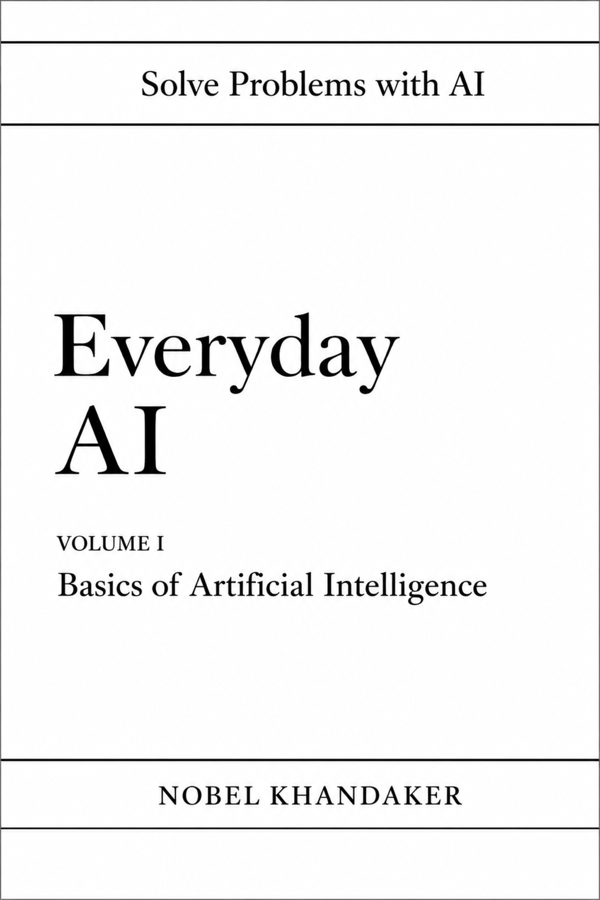
You do not need to understand a neural network to use one well. You need to know what the machine is actually doing, how to ask it for what you want, and how to tell when it is confidently wrong. This book teaches those three things and stops.
A practical guide to artificial intelligence for people with no technical background — seven chapters, written for a tenth-grade reader and up, by a lead engineer with a doctorate in computer science.
- 7chapters, start to finish
- 43sections
- 2chapters free to download
- Noneprior experience assumed
The problem this book solves
Most writing about artificial intelligence is either breathless or dismissive, and almost none of it is useful on a Tuesday afternoon when you have a document to read, a letter to write, or a problem you cannot get started on.
The breathless version tells you everything is about to change and leaves you with nothing to do about it. The dismissive version tells you it is autocomplete and leaves you unable to explain why autocomplete just rewrote a nineteenth-century letter at five reading levels in the time it takes to finish a coffee.
Everyday AI takes a third position: the machine is genuinely useful, it is genuinely limited, and both facts are learnable in an afternoon.
What it actually teaches
Chapter 1 opens in a high school south of Columbus, Ohio, where a history teacher named Maria Delgado takes a four-hundred-word complaint written by a coal miner in 1894 and, in the time it takes to finish a cup of coffee, has five versions of it pitched at five reading levels and a glossary explaining what a “scab” was. She has never written a line of code. What she has is a new kind of literacy, and it is made of exactly two habits.
Ask well. The craft of describing what you want precisely enough to get it — role, goal, context, constraints, examples, and the willingness to try again. Introduced in Chapter 3 and practiced in every chapter after it.
Check before you trust. A tool that is right ninety percent of the time is dangerous because it is so often right. Chapter 4 turns that into a rule, and Chapters 4, 5 and 6 each carry a When It Goes Wrong sidebar that works through one real failure and the quick check that catches it: the hallucinated citation, fluent prose that is confidently wrong, and the confident arithmetic slip.
Around those two habits, the book covers what the technology actually is (Chapter 2), the three tools you are most likely to touch and how they differ (Chapter 3), and then three chapters of applied skill: reading and research, writing, and learning and problem-solving. Chapter 7 is the one that keeps the rest honest — why models hallucinate, where bias comes from, what happens to what you type, and how to stay in charge of a machine that can now take actions on your behalf.
How it explains things
Most chapters open on a person in a particular moment — Maria and her Sunday, a graduate student with forty-one papers open in forty-one tabs, a tenth grader stuck on a chemistry problem at nine at night. Where one of those people is a composite drawn from how people actually work, the book says so in a footnote rather than letting you assume otherwise, which tells you something about how the rest of it is written.
Every idea that has a shape gets drawn, too — in plain characters, so the diagram works in a printed book, on a phone, and read aloud:
  +-------------------------------------------------------+
  | ARTIFICIAL INTELLIGENCE                               |
  | machines doing things we'd call "smart"               |
  |                                                       |
  |   +-----------------------------------------------+   |
  |   | MACHINE LEARNING                              |   |
  |   | programs that learn patterns from examples,   |   |
  |   | instead of being told every rule              |   |
  |   |                                               |   |
  |   |   +---------------------------------------+   |   |
  |   |   | DEEP LEARNING                         |   |   |
  |   |   | learning with many-layered            |   |   |
  |   |   | "neural networks"                     |   |   |
  |   |   |                                       |   |   |
  |   |   |   +-------------------------------+   |   |   |
  |   |   |   | LARGE LANGUAGE MODELS         |   |   |   |
  |   |   |   | deep learning, aimed at text  |   |   |   |
  |   |   |   | (ChatGPT, Claude, Gemini)     |   |   |   |
  |   |   |   +-------------------------------+   |   |   |
  |   |   +---------------------------------------+   |   |
  |   +-----------------------------------------------+   |
  +-------------------------------------------------------+
That is Figure 2.1, and it is the whole vocabulary problem in one picture: the four words everybody uses interchangeably are not rivals, they are nested. Every large language model is a kind of deep learning, which is a kind of machine learning, which is a kind of artificial intelligence. Once the words are clear, the machine stops feeling like magic and starts feeling like something you can use.
Who it is for
- Anyone who has opened a chat window and not known what to type. The book assumes no technical background whatsoever — no programming, no mathematics beyond arithmetic.
- People who use these tools already and suspect they are using them badly. Most of the gap between a vague answer and a useful one is in how the question was asked, and that is a teachable skill.
- Teachers, students, and anyone with a policy to navigate. Chapter 6 draws the line between learning with a machine and letting it do your homework — and is candid that the bill for the second one comes due on test day. Chapter 7 covers disclosure, copyright and consent, and what should never be pasted into a chatbot at all.
Who it is not for. If you want to build with these models — fine-tuning, retrieval pipelines, agent frameworks, evaluation harnesses — this is the wrong book. It is called Basics of Artificial Intelligence on purpose, and it names tools by what they are good for rather than by their APIs.
A note on shelf life
The book names real products — Claude, ChatGPT, Gemini, NotebookLM, Ollama — and quotes a real subscription price, rather than hiding behind a vagueness that would age just as badly and help less.
What it deliberately does not do is chase version numbers. Chapter 3 teaches you to read the menu — what a context window is, what a “thinking” mode buys you, when to hand the model a file instead of a question — so the chapter still works after the menu changes. Product names and prices will date. The two habits will not: asking well and checking before you trust will still be the whole game when everything in these pages has been replaced by its successor.
Start here
- Read chapters 1 and 2 free — nineteen pages, typeset exactly as the book is.
- Browse the table of contents — all seven chapters and every section.
- Errata — confirmed corrections, and how to report one.
- About the author
Everyday AI, Volume I: Basics of Artificial Intelligence — First Edition, forthcoming from Intramotev Press. The sample chapters are free to read; the full text is © Dr. Nobel Khandaker, all rights reserved.