Everyday AI: Free Sample, Chapters 1 and 2
Chapter 1, Why AI, Why Now, and Chapter 2, What Is AI and an LLM?, are yours to read free, with nothing held back and no watermark. Nineteen pages, typeset exactly as the book is.
Why these two chapters
Because they are the ones that have to work before any of the practical advice is worth taking.
Chapter 1 makes the case that this is worth your attention at all, and it makes it with numbers rather than adjectives. Chapter 2 then explains the machine — honestly, without jargon, and without the two failure modes that most explanations fall into. It does not tell you a language model thinks. It also does not tell you it is “just autocomplete” and leave you unable to explain what you saw it do.
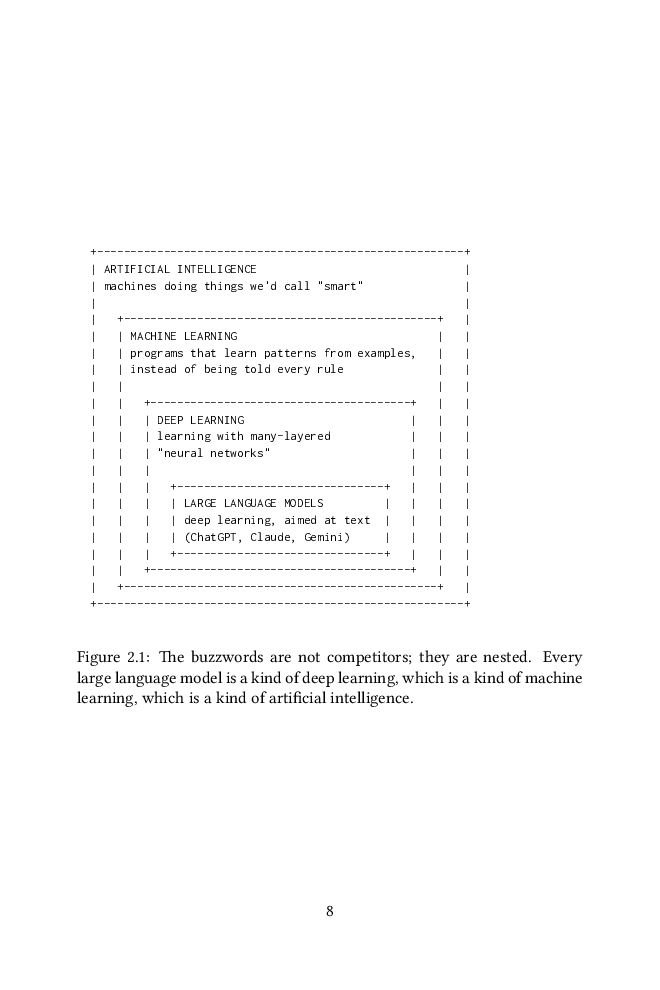
If those two chapters land — if the nested diagram makes four confusing buzzwords click into place, if you finish Chapter 2 able to say out loud why a model sounds so certain when it is wrong — then the five chapters after them will land too. If they do not, you have lost nothing.
What is in the sample
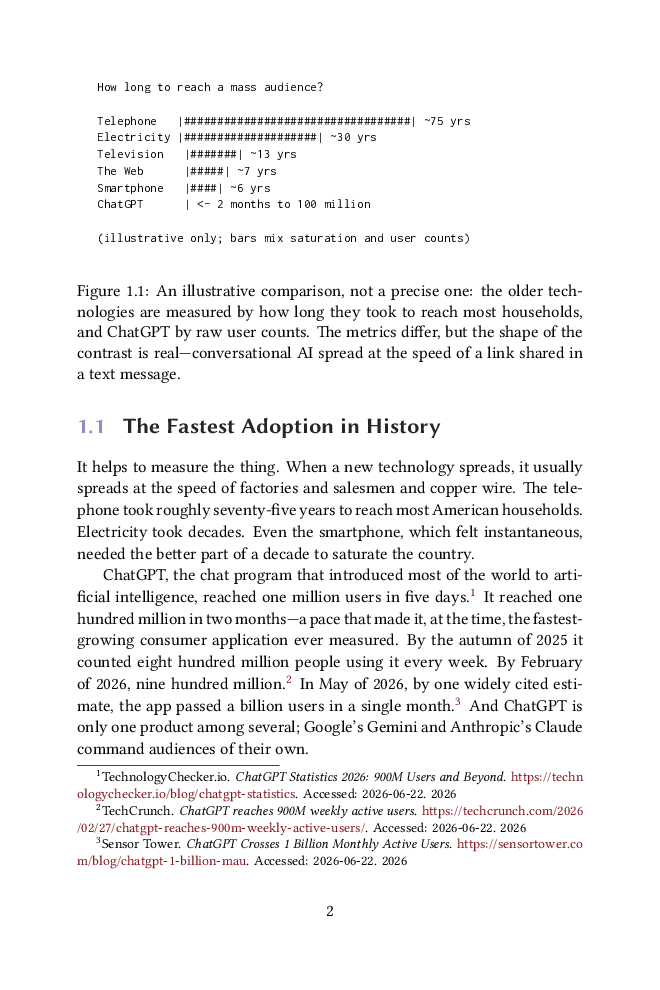
Chapter 1 — Why AI, Why Now. A history teacher in Ohio rewrites a nineteenth-century letter at five reading levels in the time it takes to finish a coffee. From that scene: how fast these tools actually spread, measured against the telephone, electricity and the smartphone; what genuinely changed between 2022 and 2026 and what is hype; the “new literacy” framing and the limits of the printing-press analogy; and what the book does and does not promise.
Chapter 2 — What Is AI and an LLM? Artificial intelligence, machine learning, deep learning and large language models, built one term from the last and drawn as four nested boxes. What the model is really doing — chopping text into tokens and predicting the next one — and why that single narrow task turns out to cover so much. Why it sounds confident when it is wrong. Whether it remembers you between sessions, answered honestly. And a first look at agents: models that act rather than only answer.
Reading notes
- The page numbers are the book’s own. The sample carries the cover, title, copyright, contents, list of figures and dedication, then Chapters 1 and 2; only the preface is held back. Chapter 1 still opens on page 1 and Chapter 2 on page 7, exactly as in the finished book, so a page reference taken from here will be right.
- A few cross-references point forward into chapters the sample does not contain — Chapter 2 hands agents on to Chapters 3 and 7, for instance. Those numbers are correct for the full book.
- Chapter 1’s ChatGPT user-count figures carry footnotes with live source links. The adoption comparison in Figure 1.1 does not, and says so in its own caption: it mixes saturation with user counts and is “illustrative only”. Noticing that distinction is the habit the book spends Chapter 4 teaching.
- The PDF is 6×9 inches, the book’s trim size. It reads comfortably on a tablet and prints on A4 or Letter without reflowing.
After the sample
Chapter 3 puts Claude, ChatGPT and Gemini side by side and turns prompting from a knack into a method. Chapters 4 through 6 apply it to reading, writing and learning. Chapter 7 is about everything that can go wrong and what to do about it. The table of contents lays out the whole route.
Found a mistake in the sample? The errata page explains how to report it. Corrections found before publication are the most useful kind.